
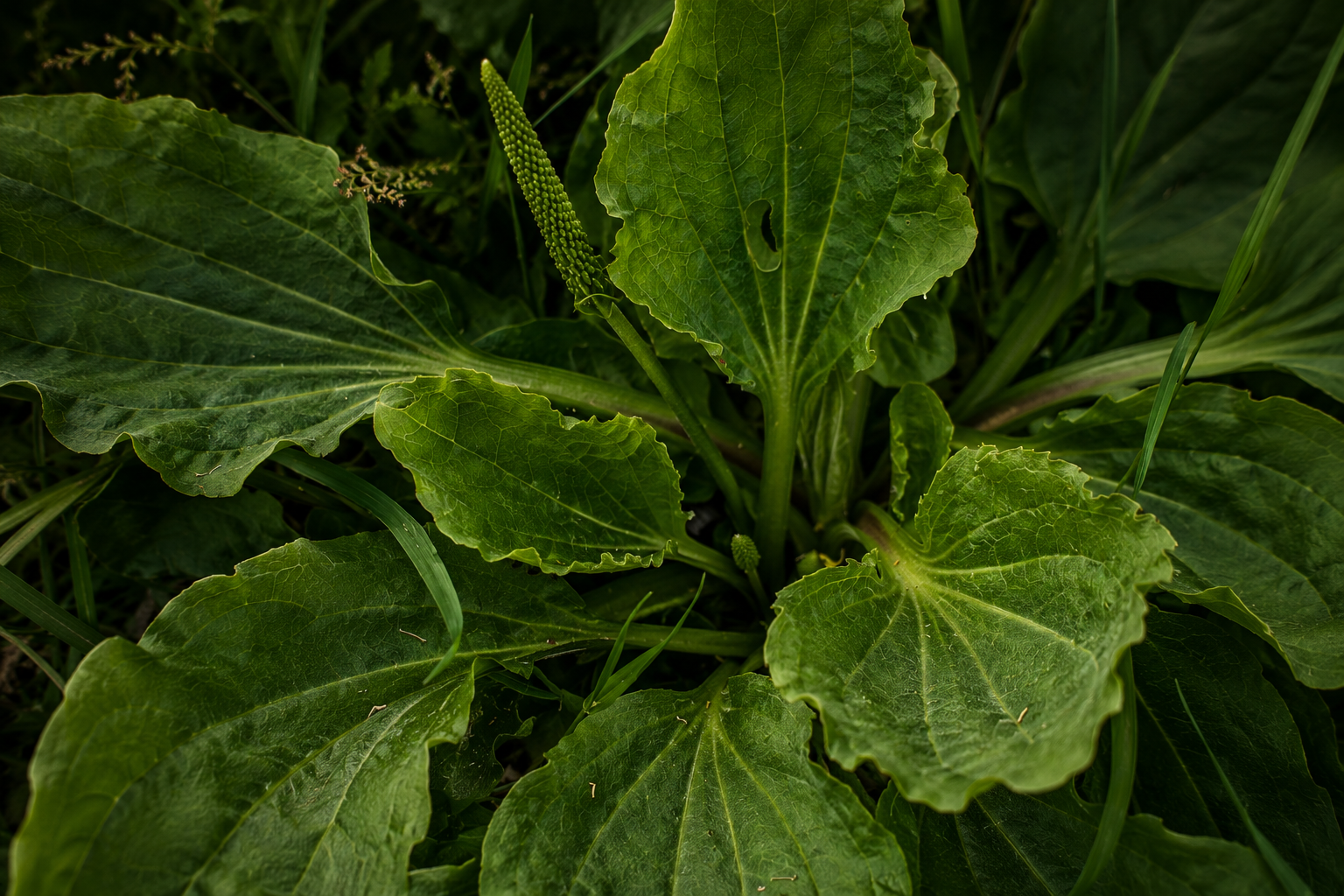
Plantain
I have a tortoise to thank for my fascination with plantain. Until Squirt came along, I thought plantain was a banana type fruit.
I was watching her eat one day and became curious about what she'd chosen. So I looked it up, discovered it was plantain, and did what I usually do when something catches my attention.
I fell down a rabbit hole.
Have you ever really looked at a plantain leaf?
Pictured above is broadleaf plantain, Plantago major, but there is also ribwort plantain, Plantago lanceolata, with its long, narrow leaves.
One of the easiest ways to recognise plantain is to turn the leaf over.
Running along its length are these wonderful raised ribs, almost like little strings beneath the surface. Once you know what you’re looking for, you start noticing plantain everywhere.
And that turned out to be incredibly useful.
Plantain contains antioxidant and anti-inflammatory compounds, which is one of the reasons it has such a long history of use on irritated and damaged skin.
That makes plantain particularly useful for skin that feels sore, irritated, reactive or unsettled.
Once I learnt what it was, I discovered how useful it could be for the ordinary little injuries that happen when you spend a lot of time outside with children.
Nettle stings. Insect bites. Scrapes. Those inevitable cries of “Mum!”
So I learnt how to identify it properly. Then I taught the kids.
And now, if somebody gets stung or bitten while we’re out and we don’t have any balm with us, we find some plantain, chew the leaf and place it straight onto the sore spot.
It’s remarkably simple. And remarkably effective.
It’s one of the plants at the very heart of Asa.
Explore plantain in our balms